There are some old fudder dudders who firmly believe that 5.56x45, .223, and similar and related calibers are a "fad" or a "failed experiment", especially for military use. Usually, they advocate a return to the full-power .308/7.62mm caliber as the end-all caliber, but some advocate for weaker calibers, like 6.8 SPC or 7.62x39. To all those who object, caliber is an important design consideration.
This post will be short: 5.56 and other small-caliber, high-velocity (SCHV) cartridges are not a fad. In fact, guns have been getting smaller and smaller in caliber, and higher and higher in velocity, for hundreds of years. Let's take a look at how infantry small arms have progressed in the 800 years or so that they've been around. (The historical overview section of this article is only intended as a cursory overview of the weapons in question. Details may have been omitted, glossed over, or compressed. I highly recommend seeking out further literature on these topics.)
1994 M4 Rifle, 62 gr .224" cal spitzer boat tail at approx 3,000 ft/s
1967 M16A1 Rifle, 55 gr .224" cal spitzer boat tail at approx 3,270 ft/s
1958 M14 Rifle, 147 gr .308" cal spitzer boat tail at approx 2,750 ft/s
1903 (1906) Springfield, 172 gr .308" cal spitzer boat tail at approx 2,640 ft/s
1903 Springfield, 220 gr .308" cal round nose at approx 2,300 ft/s
1892 Krag-Jørgensen Springfield, 220 gr .308" cal round nose at approx 2,000 ft/s
1873 Springfield Rifle-Musket, 405 gr .45" cal lead round nose at approx 1,350 ft/s
1868 Springfield Rifle-Musket, 450 gr .50" cal lead round nose at approx 1,250 ft/s
1853 Enfield Rifle-Musket, 530 gr .577" cal Minié ball at approx 900 ft/s
1700s "Kentucky" Long Rifle, ~140 gr .45" cal round ball at approx 1,500-2,000 ft/s
1717 Charleville Musket, 494 gr .69" cal round ball at approx 900 ft/s
16th Century Arquebus, 464 gr ~.68" cal round ball at approx 1,500 ft/s
14th Century Hand Gonne, 430 gr .66" cal round ball at approx 1100 ft/s
From the 18th century onward, we see a trend of ever-increasing muzzle velocity and decreasing caliber. The introduction of paper cartridges containing Minié balls allowed the use of rifle-muskets as standard infantry small arms, as they combined the ease of loading of a musket with the accuracy and range of a rifle. The introduction of the Minié ball also saw a reduction in caliber: from .69" to .58", with a slight increase in projectile weight. This resulted in much greater sectional density, which contributed to the greatly improved ballistic performance of the new rifle-muskets. Additional tests after the American Civil War showed that .50" and later .45" calibers offered even more improved performance. Eventually, .45" caliber metallic cartridges in the form of the .45-70-405 Government would be the standard for the United States for nearly two decades.
What would replace the breech-loading Springfield rifle-musket would be a smokeless powder foreign bolt action rifle firing a bullet nearly half the weight at nearly half again the muzzle velocity, the 1892 Krag-Jørgensen. The Krag would prove to have a very short service life, being replaced by the superior (and also foreign) Mauser design in the form of the 1903 Springfield rifle, possessing extremely high performance and a muzzle velocity of 2,300 ft/s. With the implementation of aerodynamic spitzer projectiles in the 1906 rifle, velocity again improved to over 2,600 ft/s, and bullet weight was significantly reduced. The example cartridge used is the M1 Ball load, introduced in 1926, but higher velocity loads like M1906 Ball and M2 Ball were used extensively, both of which fired ~150 gr flat based bullets at 2,800 ft/s. Since the .30-06 cartridge comes in almost endless variations with different bullet weights and velocities, the M1 Ball type used here is intended to be representative of the caliber in general.
The self-loading era begins with the M1 Garand, also in .30-06, producing performance very similar to that of the Springfield or M14, with a 150 gr flat-based projectile fired at 2,800 feet per second. Because for the purposes of this discussion, it is highly similar to the M14, it has been omitted. After WWII, a program was initiated to develop a lighter magazine-fed select-fire rifle, and resulted, after over a decade of research and testing, in the M14, which was only an incremental improvement over the Garand upon which it is based. The M14, like the Krag before it, would see service as a standard rifle for less than a decade, though it would continue to be used in specialist roles up to the present day.
The next significant innovation in small arms was what is sometimes called "small-caliber, high-velocity" ammunition, but which in reality was just a continuation of a trend stretching back hundreds of years. US Army studies again suggested that a smaller caliber, lighter bullet, fired at a higher muzzle velocity was desirable, and after a period of development, the resulting 5.56mm cartridge was born, mated to the advanced ArmaLite rifle design. The ArmaLite rifle was unlike previous US Army rifles in many ways, perhaps not the least significant of which was the method of its development. Previous Army designs were developed by Army Ordnance, but the ArmaLite rifle was an independent development by a USMC officer-turned-Army Ordnance Colonel and an aircraft design engineer, in the employ of a division of Fairchild, an aircraft manufacturer. The original AR-10 design, in the same full-power caliber as the M14, competed in the light rifle trials, but was unsuccessful due to the exotic composite barrel, which burst during testing. The later AR-15 design, using the basic principles of the AR-10, but adapted for a much smaller .22" caliber cartridge at the request of Army Field Forces Board No. 3. The combination proved wildly successful, and a derivative design, the shorter M4 Carbine, remains the standard infantry weapon of the United States Army today.
Jumping backward in time, The "Kentucky" rifles collectively present an outlier, being much higher velocity and smaller caliber than their contemporaries. This was largely due to their tight rifling and sturdy construction, which incidentally made them unsuitable for use as a standard infantry arm, as they could not be loaded quickly. It did however foreshadow the improvements that would be made to rifle performance as rifling, Minié balls, and breechloading mechanisms allowed rifle-muskets to catch up to their civilian rifled cousins. The "Kentucky" rifles do not represent the state of military small arms at the time, but are included for completeness only.
A very strange anomaly can be seen at the bottom of the table, with both the 16th Century arquebus and 14th Century hand-gonne. Both have higher velocity than the later Charleville musket! Why is this? I do not know for sure, but I suspect that during this period, great emphasis was placed on defeating the personal body armor of the time. To do this would require considerable velocity using the bare lead round ball projectiles of the time. By the 18th century, all that was left of the heavy plate worn by infantry and cuirassiers of the 16th century was the gorget - a decorative neck-guard used as a status symbol. Without the need to penetrate heavy armor, and with no real ability of an individual to hit targets at beyond 20 yards with a smoothbore musket, velocity decreased.
Since the 18th century, the caliber and projectile weight of small arms have progressively decreased, while the muzzle velocity has progressively increased. The change from 7.62mm caliber rifles to 5.56mm caliber rifles follows this trend, and I expect sometime in the future that the 5.56mm caliber will be obsolesced by something even smaller, lighter, and higher velocity.
EDIT: Turns out, by pure serendipity, diving through the Weaponsman archives digs up a very similar article they wrote on the exact same subject a while back. Readers may find it interesting.
Wednesday, October 23, 2013

Thursday, April 11, 2013
What is a clip? What is not a clip?
You've just gotten into firearms. It's a new, strange world full of opinions, history, and lots of marketing. You and your friend, who's been into guns for ages, it seems, go to the gun store for a look around. You've just bought a Savage Model 64 a few weeks back, and you've had a hard time finding any of the little ugly black aluminum bits that hold the ammunition. You come up to the gun counter, get the attention of a clerk, and ask:
The clerk groans and rolls his eyes. You look back at your friend, wondering what you did, and he looks a little embarrassed, but he's making a noble effort to hide it. What went wrong?
Gun owners can be very sensitive about this little quirk of firearm terminology. "Clip" is a flag to many of them that says "I am an idiot; I learned everything I know about firearms from TV, and if you interact with me for any length of time, I will make your day difficult." Sadly, like many people who use the term "clip" to mean "thing you load your gun with", you just want a magazine or two, and to go about your day.
Well, you can't change gun owners. If you could, no one would use lever actions anymore. Nah, we're all a bunch of sticks in the mud, and often pretty loud about it, too. It's better, trust me, to just play along, and learn the difference between a magazine, and a clip.
There are a number of resources online which aim to teach this difference. All the ones I have seen do not quite reach the mark. I will attempt to give the most concise, but widely-applicable definition that I can.
Sheesh! That was a mouthful! Why does it have to be that way?
Clips, almost always, contain springs. From SKS stripper clips, to revolver moon clips, it's extremely common for clips to be sprung or contain springs. The important distinction here lies in what the spring does. In virtually all clips I'm aware of, the spring acts to hold the rounds in the clip. In a magazine, the mainspring performs two, or even three functions:
1. To hold the rounds in the magazine.
2. To push the next round into the feeding position, after a round has been stripped from the magazine.
3. (often) To hold the magazine together.
To this end, the springs in magazines are usually large, coiled wire springs, which are a separate part. Because of these large, dedicated springs, magazines are usually much, much more expensive than clips.
As if things needed to be more complicated, not all clips are springs, however. This .303 British 5-round clip holds its cartridges in primarily by friction. It is somewhat springy, but if you were to polish the inside of the clip to 400 grit, it probably would not hold the rounds in place any more.
The video by Life, Liberty, Etc claims that "clips are for loading magazines, and magazines are for loading the breech." While this is often true, in many cases it is not. For instance, with revolver moon clips, there is no magazine, and the clip holds ammunition in place while it is seated in the chambers, and merely simplify loading and unloading by making the ammunition a single unit. With a Garand en-bloc clip, the ammunition is loaded into the magazine, but it is the en-bloc clip's feed lips which hold the ammunition in the proper feeding position as it is rammed by the bolt into the chamber. The next round of ammunition is then forced into position by the internal magazine's spring. In this way, the clip and magazine work together as a unit to allow the gun to function.
The above is a lot to remember, for anyone. The Life, Liberty, Etc definition is a bit shorter, but it doesn't really help you if you see some nondescript clip-like object at the gun show and want to know if it's a magazine or a clip. Here's perhaps a more helpful mnemonic:
Clips are almost always simpler, and thus cheaper than magazines. Often, they are downright disposable. It's not uncommon for someone to spend more than $20 on a single magazine, even for used examples, but you might spend $20 on a bag of 50 clips without being branded a thief. The fact that "cheap" and "clip", and "expensive" and "magazine" have the same number of syllables, respectively, should help the reader remember, in general, which is which.
There are endless permutations to clips and magazines, some (thankfully, very rare) blurring the line between the two. Hopefully, however, this article has given the reader some insight into which is which, and why gun owners are so anal about the difference between the two.
"Hi, you got any clips for a Savage .22?"
The clerk groans and rolls his eyes. You look back at your friend, wondering what you did, and he looks a little embarrassed, but he's making a noble effort to hide it. What went wrong?
Gun owners can be very sensitive about this little quirk of firearm terminology. "Clip" is a flag to many of them that says "I am an idiot; I learned everything I know about firearms from TV, and if you interact with me for any length of time, I will make your day difficult." Sadly, like many people who use the term "clip" to mean "thing you load your gun with", you just want a magazine or two, and to go about your day.
Well, you can't change gun owners. If you could, no one would use lever actions anymore. Nah, we're all a bunch of sticks in the mud, and often pretty loud about it, too. It's better, trust me, to just play along, and learn the difference between a magazine, and a clip.
There are a number of resources online which aim to teach this difference. All the ones I have seen do not quite reach the mark. I will attempt to give the most concise, but widely-applicable definition that I can.
The term "clip" refers to devices made of (usually) a single piece of stamped and/or bent metal which retains rounds ammunition for the purpose of feeding into a weapon or magazine, and which does not contain a spring for advancing the cartridges to the chamber during cycling.
Sheesh! That was a mouthful! Why does it have to be that way?
Clips, almost always, contain springs. From SKS stripper clips, to revolver moon clips, it's extremely common for clips to be sprung or contain springs. The important distinction here lies in what the spring does. In virtually all clips I'm aware of, the spring acts to hold the rounds in the clip. In a magazine, the mainspring performs two, or even three functions:


1. To hold the rounds in the magazine.
2. To push the next round into the feeding position, after a round has been stripped from the magazine.
3. (often) To hold the magazine together.
To this end, the springs in magazines are usually large, coiled wire springs, which are a separate part. Because of these large, dedicated springs, magazines are usually much, much more expensive than clips.
As if things needed to be more complicated, not all clips are springs, however. This .303 British 5-round clip holds its cartridges in primarily by friction. It is somewhat springy, but if you were to polish the inside of the clip to 400 grit, it probably would not hold the rounds in place any more.

The video by Life, Liberty, Etc claims that "clips are for loading magazines, and magazines are for loading the breech." While this is often true, in many cases it is not. For instance, with revolver moon clips, there is no magazine, and the clip holds ammunition in place while it is seated in the chambers, and merely simplify loading and unloading by making the ammunition a single unit. With a Garand en-bloc clip, the ammunition is loaded into the magazine, but it is the en-bloc clip's feed lips which hold the ammunition in the proper feeding position as it is rammed by the bolt into the chamber. The next round of ammunition is then forced into position by the internal magazine's spring. In this way, the clip and magazine work together as a unit to allow the gun to function.

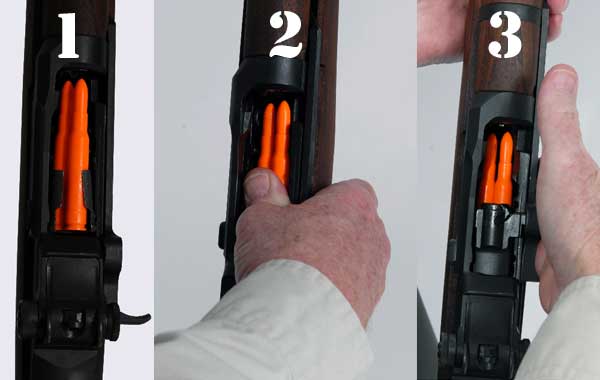
The above is a lot to remember, for anyone. The Life, Liberty, Etc definition is a bit shorter, but it doesn't really help you if you see some nondescript clip-like object at the gun show and want to know if it's a magazine or a clip. Here's perhaps a more helpful mnemonic:
"Cheap clips, expensive magazines".
Clips are almost always simpler, and thus cheaper than magazines. Often, they are downright disposable. It's not uncommon for someone to spend more than $20 on a single magazine, even for used examples, but you might spend $20 on a bag of 50 clips without being branded a thief. The fact that "cheap" and "clip", and "expensive" and "magazine" have the same number of syllables, respectively, should help the reader remember, in general, which is which.
There are endless permutations to clips and magazines, some (thankfully, very rare) blurring the line between the two. Hopefully, however, this article has given the reader some insight into which is which, and why gun owners are so anal about the difference between the two.
Friday, February 15, 2013
The Cult of Caliber
Nearly every American firearms enthusiast has been to a gun store, a gun show, a gun forum, or some other gun-related venue, and heard:
And, if you haven't yet, you will.
What is it about specific calibers, be it .308 or .45 or something else, that really turns people on? After all, it's just a measurement of one particular area on the projectile. A fetish for bullet mass, or better yet cartridge muzzle energy, would make more sense. Yet, there it is.
Today I want to address two specific hymns sung by acolytes of the Cult of Caliber, the first being this:
Variations on this theme appear everywhere, even some well respected defense journals. But something has been bugging me about it.
The first is, isn't this basically the same as saying "if a 5.56 round hits a target and performs exactly like a .22 LR, then it won't be any more effective than a .22 LR"? It may be true, but besides being a bit disingenuous by singling out 5.56, it doesn't really seem useful, as it doesn't tell us anything about how likely it is that 5.56 will perform like a .22.
My other objection is that there's nothing special about a caliber. It's just a measurement, either the diameter from one land to another, the diameter of the grooves, the diameter of the projectile itself, or even just some arbitrary number that's kinda close to one of those measurements. There aren't any caliber-specific performance nodes where one caliber has something special going for it over another.* The statement above frames the situation as if 5.56 has some special quality, that other calibers don't have, which is detrimental to its terminal effectiveness. Even assuming the above statement were true, why would 5.56 be special? Shouldn't the below statement be just as true?
.32 ACP from a handgun produces about as much energy as .22 LR from a rifle. It's almost certainly not any more effective. How then, even if the oft-heard statement about 5.56 were true, would it inform us about any deficiency in the cartridge? And if it's not true, why take it seriously?
A similar, but different quip is also often heard, relating to 5.56's parental history:
While it's true that the .222 Remington was and is popular with varmint hunters, the 5.56 was, with some very explicit supporting evidence, designed specifically as a battle cartridge. Indeed, one could as easily say that the 7.62 is just an overgrown varmint cartridge, it being the same caliber as the .32-20, which was a common caliber for small game in previous years. This quip is a bit more banal, and really isn't based on anything but semantics. A chambering isn't good for only one thing; just because the .222 Remington sees a lot of use as a (long range) varmint cartridge doesn't mean that you couldn't easily kill a person with it, or that it's only effective against varmints. Considering the fact that varmints are usually dispatched by blowing gigantic holes in them, a "varmint" cartridge loaded with appropriate bullets might be a real man-stopper.
It's simply not appropriate to judge a cartridge by its caliber alone. Caliber is just a measurement; high velocity bullets are not like icepicks; they do not simply poke a hole of their size and shape, even if they don't do anything exotic. For example, here's a video of a perfectly stable .30 Carbine bullet impacting a block of gelatin and doing some pretty dramatic things to it. This post isn't intended to settle whether 5.56 is a good man-stopper or not once and for all (I was hoping its steady half century of use for that purpose would), but I am hoping I've thoroughly put down those two particular arguments.
*This isn't entirely true, as propensity for yaw actually scales with caliber. Here's a paper describing the phenomenon. However, this assumes homologous bullets, and so you could have a .30 caliber bullet that yaws as easily as a .22 caliber bullet, etc., if they weren't homologous.
"Yeah, I don't carry a [gun of X type] that isn't in [a specific caliber, a caliber above X arbitrary value, etc]."
And, if you haven't yet, you will.
What is it about specific calibers, be it .308 or .45 or something else, that really turns people on? After all, it's just a measurement of one particular area on the projectile. A fetish for bullet mass, or better yet cartridge muzzle energy, would make more sense. Yet, there it is.
Today I want to address two specific hymns sung by acolytes of the Cult of Caliber, the first being this:
"If a 5.56 round fails to [tumble/fragment/expand], then what you really have is just a glorified .22."
Variations on this theme appear everywhere, even some well respected defense journals. But something has been bugging me about it.
The first is, isn't this basically the same as saying "if a 5.56 round hits a target and performs exactly like a .22 LR, then it won't be any more effective than a .22 LR"? It may be true, but besides being a bit disingenuous by singling out 5.56, it doesn't really seem useful, as it doesn't tell us anything about how likely it is that 5.56 will perform like a .22.
My other objection is that there's nothing special about a caliber. It's just a measurement, either the diameter from one land to another, the diameter of the grooves, the diameter of the projectile itself, or even just some arbitrary number that's kinda close to one of those measurements. There aren't any caliber-specific performance nodes where one caliber has something special going for it over another.* The statement above frames the situation as if 5.56 has some special quality, that other calibers don't have, which is detrimental to its terminal effectiveness. Even assuming the above statement were true, why would 5.56 be special? Shouldn't the below statement be just as true?

"If a 7.62 round fails to tumble, fragment, or expand, then what you really have is just a glorified .32 ACP."
.32 ACP from a handgun produces about as much energy as .22 LR from a rifle. It's almost certainly not any more effective. How then, even if the oft-heard statement about 5.56 were true, would it inform us about any deficiency in the cartridge? And if it's not true, why take it seriously?
A similar, but different quip is also often heard, relating to 5.56's parental history:
"5.56 is based on the .222 Remington, which was intended as a varmint cartridge."
While it's true that the .222 Remington was and is popular with varmint hunters, the 5.56 was, with some very explicit supporting evidence, designed specifically as a battle cartridge. Indeed, one could as easily say that the 7.62 is just an overgrown varmint cartridge, it being the same caliber as the .32-20, which was a common caliber for small game in previous years. This quip is a bit more banal, and really isn't based on anything but semantics. A chambering isn't good for only one thing; just because the .222 Remington sees a lot of use as a (long range) varmint cartridge doesn't mean that you couldn't easily kill a person with it, or that it's only effective against varmints. Considering the fact that varmints are usually dispatched by blowing gigantic holes in them, a "varmint" cartridge loaded with appropriate bullets might be a real man-stopper.
It's simply not appropriate to judge a cartridge by its caliber alone. Caliber is just a measurement; high velocity bullets are not like icepicks; they do not simply poke a hole of their size and shape, even if they don't do anything exotic. For example, here's a video of a perfectly stable .30 Carbine bullet impacting a block of gelatin and doing some pretty dramatic things to it. This post isn't intended to settle whether 5.56 is a good man-stopper or not once and for all (I was hoping its steady half century of use for that purpose would), but I am hoping I've thoroughly put down those two particular arguments.
*This isn't entirely true, as propensity for yaw actually scales with caliber. Here's a paper describing the phenomenon. However, this assumes homologous bullets, and so you could have a .30 caliber bullet that yaws as easily as a .22 caliber bullet, etc., if they weren't homologous.
Sunday, December 23, 2012
Revolvers are shockingly inefficient
I was over at Ballistics By The Inch, checking out barrel length data on the .357 Magnum, when I noticed that revolvers lose quite a lot of energy versus non-revolver designs. Remembering that revolver barrels are measured differently than those of fixed-chamber designs (for a .357 Magnum gun, add about 1.65" to the nominal length to compensate for the cylinder), we see a dramatic difference in energy produced between the T/C Encore and the Colt Python:
(Given that the barrel-plus-chamber length of the Python is approximately 7.65", I am estimating a 7.5" barrel for the Encore by averaging the performance from 8" and 7" barrels.)
7.5" T/C Encore
Cor-Bon 110 gr. JHP: 484 m/s, 837 J
Cor-Bon 125 gr. JHP: 554 m/s, 1,244 J
Cor-Bon 140 gr. JHP: 516 m/s, 1,210 J
Cor-Bon 125 gr. DPX: 520 m/s, 1,094 J
Federal 125 gr. JHP: 549 m/s, 1,221 J
Federal 158 gr. JHP: 470 m/s, 1,133 J
6" (actually ~7.65") Colt Python
Cor-Bon 110 gr. JHP: 390 m/s, 541 J (35% lost)
Cor-Bon 125 gr. JHP: 419 m/s, 710 J (43% lost)
Cor-Bon 140 gr. JHP: 362 m/s, 593 J (51% lost)
Cor-Bon 125 gr. DPX: 401 m/s, 650 J (41% lost)
Federal 125 gr. JHP: 420 m/s, 713 J (41% lost)
Federal 158 gr. JHP: 358 m/s, 657 J (42% lost)
Oddly, the 4" S&W loses less energy than the Colt. There are a number of factors that could account for this (smaller gap, tighter rifling, tighter forcing cone, etc):
5.5" T/C Encore
Cor-Bon 110 gr. JHP: 433 m/s, 667 J
Cor-Bon 125 gr. JHP: 507 m/s, 1043 J
Cor-Bon 140 gr. JHP: 468 m/s, 996 J
Cor-Bon 125 gr. DPX: 488 m/s, 964 J
Federal 125 gr. JHP: 499 m/s, 1008 J
Federal 158 gr. JHP: 433 m/s, 958 J
4" (actually 5.67") S&W 686
Cor-Bon 110 gr. JHP: 409 m/s, 595 J (11% lost)
Cor-Bon 125 gr. JHP: 450 m/s, 821 J (21% lost)
Cor-Bon 140 gr. JHP: 391 m/s, 695 J (30% lost)
Cor-Bon 125 gr. DPX: 438 m/s, 779 J (19% lost)
Federal 125 gr. JHP: 438 m/s, 776 J (23% lost)
Federal 158 gr. JHP: 380 m/s, 739 J (23% lost)
So, in general, you're probably losing somewhere between 20-40% of your energy because of the cylinder gap.
For comparison, here's 9mm Luger from both a 7.5" and 5.5" Encore and a 4.875" barreled Beretta 92FS:
7.5" T/C Encore
Cor-Bon 90 gr. JHP +P: 495 m/s, 717 J
Cor-Bon 115 gr. JHP +P: 443 m/s, 730 J
Cor-Bon 125 gr. JHP +P: 411 m/s, 694 J
Cor-Bon 115 gr. DPX: 414 m/s, 639 J
Federal 115 gr. JHP: 375 m/s, 523 J
Federal 124 gr. Hydra-Shok JHP: 357 m/s, 512 J
Federal 147 gr. Hydra-Shok JHP: 318 m/s, 482 J
5.5" T/C Encore
Cor-Bon 90 gr. JHP +P: 473 m/s, 653 J
Cor-Bon 115 gr. JHP +P: 423 m/s, 666 J
Cor-Bon 125 gr. JHP +P: 395 m/s, 633 J
Cor-Bon 115 gr. DPX: 404 m/s, 607 J
Federal 115 gr. JHP: 359 m/s, 480 J
Federal 124 gr. Hydra-Shok JHP: 342 m/s, 471 J
Federal 147 gr. Hydra-Shok JHP: 311 m/s, 459 J
4.875" Beretta 92FS
Cor-Bon 90 gr. JHP +P: 464 m/s, 628 J
Cor-Bon 115 gr. JHP +P: 422 m/s, 663 J
Cor-Bon 125 gr. JHP +P: 394 m/s, 628 J
Cor-Bon 115 gr. DPX: 390 m/s, 568 J
Federal 115 gr. JHP: 343 m/s, 438 J
Federal 124 gr. Hydra-Shok JHP: 340 m/s, 464 J
Federal 147 gr. Hydra-Shok JHP: 302 m/s, 433 J
9mm +P is hot stuff, producing around 80% of the energy of .357 Magnum as fired from a revolver. Most modern 9mm handguns are fine with shooting a steady diet of +P ammunition, in fact more so than some .357 Magnum revolvers are with shooting factory magnum ammunition.
(Given that the barrel-plus-chamber length of the Python is approximately 7.65", I am estimating a 7.5" barrel for the Encore by averaging the performance from 8" and 7" barrels.)
7.5" T/C Encore
Cor-Bon 110 gr. JHP: 484 m/s, 837 J
Cor-Bon 125 gr. JHP: 554 m/s, 1,244 J
Cor-Bon 140 gr. JHP: 516 m/s, 1,210 J
Cor-Bon 125 gr. DPX: 520 m/s, 1,094 J
Federal 125 gr. JHP: 549 m/s, 1,221 J
Federal 158 gr. JHP: 470 m/s, 1,133 J
6" (actually ~7.65") Colt Python
Cor-Bon 110 gr. JHP: 390 m/s, 541 J (35% lost)
Cor-Bon 125 gr. JHP: 419 m/s, 710 J (43% lost)
Cor-Bon 140 gr. JHP: 362 m/s, 593 J (51% lost)
Cor-Bon 125 gr. DPX: 401 m/s, 650 J (41% lost)
Federal 125 gr. JHP: 420 m/s, 713 J (41% lost)
Federal 158 gr. JHP: 358 m/s, 657 J (42% lost)
Oddly, the 4" S&W loses less energy than the Colt. There are a number of factors that could account for this (smaller gap, tighter rifling, tighter forcing cone, etc):
5.5" T/C Encore
Cor-Bon 110 gr. JHP: 433 m/s, 667 J
Cor-Bon 125 gr. JHP: 507 m/s, 1043 J
Cor-Bon 140 gr. JHP: 468 m/s, 996 J
Cor-Bon 125 gr. DPX: 488 m/s, 964 J
Federal 125 gr. JHP: 499 m/s, 1008 J
Federal 158 gr. JHP: 433 m/s, 958 J
4" (actually 5.67") S&W 686
Cor-Bon 110 gr. JHP: 409 m/s, 595 J (11% lost)
Cor-Bon 125 gr. JHP: 450 m/s, 821 J (21% lost)
Cor-Bon 140 gr. JHP: 391 m/s, 695 J (30% lost)
Cor-Bon 125 gr. DPX: 438 m/s, 779 J (19% lost)
Federal 125 gr. JHP: 438 m/s, 776 J (23% lost)
Federal 158 gr. JHP: 380 m/s, 739 J (23% lost)
So, in general, you're probably losing somewhere between 20-40% of your energy because of the cylinder gap.
For comparison, here's 9mm Luger from both a 7.5" and 5.5" Encore and a 4.875" barreled Beretta 92FS:
7.5" T/C Encore
Cor-Bon 90 gr. JHP +P: 495 m/s, 717 J
Cor-Bon 115 gr. JHP +P: 443 m/s, 730 J
Cor-Bon 125 gr. JHP +P: 411 m/s, 694 J
Cor-Bon 115 gr. DPX: 414 m/s, 639 J
Federal 115 gr. JHP: 375 m/s, 523 J
Federal 124 gr. Hydra-Shok JHP: 357 m/s, 512 J
Federal 147 gr. Hydra-Shok JHP: 318 m/s, 482 J
5.5" T/C Encore
Cor-Bon 90 gr. JHP +P: 473 m/s, 653 J
Cor-Bon 115 gr. JHP +P: 423 m/s, 666 J
Cor-Bon 125 gr. JHP +P: 395 m/s, 633 J
Cor-Bon 115 gr. DPX: 404 m/s, 607 J
Federal 115 gr. JHP: 359 m/s, 480 J
Federal 124 gr. Hydra-Shok JHP: 342 m/s, 471 J
Federal 147 gr. Hydra-Shok JHP: 311 m/s, 459 J
4.875" Beretta 92FS
Cor-Bon 90 gr. JHP +P: 464 m/s, 628 J
Cor-Bon 115 gr. JHP +P: 422 m/s, 663 J
Cor-Bon 125 gr. JHP +P: 394 m/s, 628 J
Cor-Bon 115 gr. DPX: 390 m/s, 568 J
Federal 115 gr. JHP: 343 m/s, 438 J
Federal 124 gr. Hydra-Shok JHP: 340 m/s, 464 J
Federal 147 gr. Hydra-Shok JHP: 302 m/s, 433 J
9mm +P is hot stuff, producing around 80% of the energy of .357 Magnum as fired from a revolver. Most modern 9mm handguns are fine with shooting a steady diet of +P ammunition, in fact more so than some .357 Magnum revolvers are with shooting factory magnum ammunition.
Wednesday, December 5, 2012
The Cheaper Man
It is often repeated in gun nut corners of the Internet that small "spray and pray" rifles (as some derisively call weapons like the AR-15 or AK) are not needed, if one only is willing to train their soldiers and marines better.
They clearly haven't read their Kipling:
They clearly haven't read their Kipling:
A great and glorious thing it is
To learn, for seven years or so,
The Lord knows what of that and this,
Ere reckoned fit to face the foe--
The flying bullet down the Pass,
That whistles clear: "All flesh is grass."
Three hundred pounds per annum spent
On making brain and body meeter
For all the murderous intent
Comprised in "villainous saltpetre!"
And after--ask the Yusufzaies
What comes of all our 'ologies.
A scrimmage in a Border Station--
A canter down some dark defile--
Two thousand pounds of education
Drops to a ten-rupee jezail--
The Crammer's boast, the Squadron's pride,
Shot like a rabbit in a ride!
No proposition Euclid wrote,
No formulae the text-books know,
Will turn the bullet from your coat,
Or ward the tulwar's downward blow
Strike hard who cares--shoot straight who can--
The odds are on the cheaper man.
One sword-knot stolen from the camp
Will pay for all the school expenses
Of any Kurrum Valley scamp
Who knows no word of moods and tenses,
But, being blessed with perfect sight,
Picks off our messmates left and right.
With home-bred hordes the hillsides teem,
The troop-ships bring us one by one,
At vast expense of time and steam,
To slay Afridis where they run.
The "captives of our bow and spear"
Are cheap--alas! as we are dear.
Arithmetic on the Frontier, by Rudyard Kipling
Certainly, great skill is required to accomplish certain things, like flying a helicopter, and those that perform their tasks well will be pound-for-pound better than those that do theirs poorly. Yet, it is the sorry reality that skill at something does not scale linearly with training. If a rapid course in riflemanship takes 20 hours, but total mastery takes 10,000 hours, then a nation holding its soldiers only to the standards of the rapid course will be able to field two and a half orders of magnitude as many soldiers as the latter. Is a master rifleman good enough to kill 500 "OK" riflemen? Most likely, no.
The ubiquity of special forces in militaries worldwide speaks to a recognition of the value of great skill in warfare, but for the average soldier, the appropriate standard is usually the lowest one that's still capable of carrying out the task given to them.
Saturday, December 1, 2012
The Largest Centerfire Rifle Ever Made?
So claims the title of this video, showcasing JD Jones' very large .950 JDJ rifle.
I've seen this video swimming around on the Interwebs a few times, usually with that claim either in the title or description.
Is the .950 JDJ rifle the largest centerfire rifle ever made?
The answer is "it's complicated" and also "no".
The qualification of "centerfire" begs the question: Does electrical priming count? It's normally located in the center of the cartridge, and it is a priming method, so is it "centerfire" or not? If it doesn't count, does that mean that the .950 JDJ is the largest bore cartridge that primes via standard Large Rifle Primers? If so, why is that significant?
Beyond that, we can then argue whether "rifle" refers to a firearm that is shoulder-fired and rifled, or just rifled, because neglecting the shoulder-fired requirement, there are of course a whole host of larger-caliber weapons than the .950 JDJ. For the purposes of this article, I'll assume that "rifle" refers to any firearm that is shoulder-fired and rifled, because that makes the competition much more interesting.
In fact, a number of centerfire rifles out-bore the .950 JDJ. The XM109, a 25mm anti-materiel rifle, has a bore of around .973". There are numerous 4-bore rifles in the world, and, though the exact diameter of a "4-bore" varies from maker to maker, a number of them measure over 1" in diameter. The video I just linked even proves that the .950 JDJ isn't even the largest bore centerfire rifle to become an Internet sensation!
Moving on, every grenadier who served from Vietnam until now should raise an eyebrow at the title of this video, as they used rifles of much greater diameter during their service.
Going even bigger, we have the various recoilless rifles of the world. While perhaps the most famous, the 84mm Carl Gustav does not actually qualify for the purposes of this article, because it is side-priming. However, numerous centerfire recoilless rifles exist. Among those that are also shoulder-fired, we have the M18 57mm (2.24") rifle, which has almost 2 and a half times the bore diameter of the JDJ (more here, and here); and the M67 90mm (3.54") recoilless rifle, with a bore nearly four times as wide as the JDJ.
At the risk of going a bit smaller, there's also the very interesting 76mm High Impulse Weapon System, which is notable in that it does not redirect any of the energy of the cartridge to help mitigate recoil.
This isn't intended to be a slam post against JD Jones; they make some really interesting stuff. I bet that .950 is a hoot to shoot (though maybe the one guy with a cracked rib didn't think so), but just remember, the next time somebody claims to have made the "largest", "biggest" or "most powerful"... They've probably been outdone before they even started.
I've seen this video swimming around on the Interwebs a few times, usually with that claim either in the title or description.
Is the .950 JDJ rifle the largest centerfire rifle ever made?
The answer is "it's complicated" and also "no".
The qualification of "centerfire" begs the question: Does electrical priming count? It's normally located in the center of the cartridge, and it is a priming method, so is it "centerfire" or not? If it doesn't count, does that mean that the .950 JDJ is the largest bore cartridge that primes via standard Large Rifle Primers? If so, why is that significant?

Beyond that, we can then argue whether "rifle" refers to a firearm that is shoulder-fired and rifled, or just rifled, because neglecting the shoulder-fired requirement, there are of course a whole host of larger-caliber weapons than the .950 JDJ. For the purposes of this article, I'll assume that "rifle" refers to any firearm that is shoulder-fired and rifled, because that makes the competition much more interesting.
In fact, a number of centerfire rifles out-bore the .950 JDJ. The XM109, a 25mm anti-materiel rifle, has a bore of around .973". There are numerous 4-bore rifles in the world, and, though the exact diameter of a "4-bore" varies from maker to maker, a number of them measure over 1" in diameter. The video I just linked even proves that the .950 JDJ isn't even the largest bore centerfire rifle to become an Internet sensation!
Moving on, every grenadier who served from Vietnam until now should raise an eyebrow at the title of this video, as they used rifles of much greater diameter during their service.
Going even bigger, we have the various recoilless rifles of the world. While perhaps the most famous, the 84mm Carl Gustav does not actually qualify for the purposes of this article, because it is side-priming. However, numerous centerfire recoilless rifles exist. Among those that are also shoulder-fired, we have the M18 57mm (2.24") rifle, which has almost 2 and a half times the bore diameter of the JDJ (more here, and here); and the M67 90mm (3.54") recoilless rifle, with a bore nearly four times as wide as the JDJ.
At the risk of going a bit smaller, there's also the very interesting 76mm High Impulse Weapon System, which is notable in that it does not redirect any of the energy of the cartridge to help mitigate recoil.
This isn't intended to be a slam post against JD Jones; they make some really interesting stuff. I bet that .950 is a hoot to shoot (though maybe the one guy with a cracked rib didn't think so), but just remember, the next time somebody claims to have made the "largest", "biggest" or "most powerful"... They've probably been outdone before they even started.
Subscribe to:
Posts (Atom)